In August 2025, Communities for Our Colleges (C4C) convened ninety-six students and community members from across Washington State in Spokane for the annual Student Power Building Conference. Over three days, participants engaged in trainings, storytelling, policy development, and cultural activities aimed at building a stronger statewide student network and advancing a collective vision for higher education justice. The conference was intentionally bilingual and intergenerational, creating space for students of color, first-generation, immigrant, undocumented, parenting, and low-income students to lead conversations about the future of Washington’s community & technical colleges.
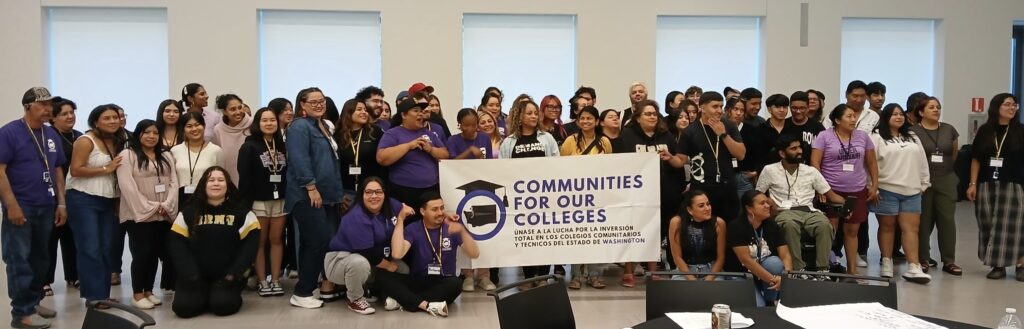
The purpose of this gathering was clear: to transform fear and disempowerment into collective action. In a political moment where immigrant families face threats of deportation and austerity policies threaten public education, the conference served as both a strategy session and an act of defense. Students reaffirmed their commitment to community-led solutions rooted in solidarity, courage, and care.
Program Highlights
The conference opened with activities to ground participants in community and vision, including a justice conversation that helped students define justice in their own terms and connect it to their lived realities. A justice panel featuring C4C leaders, faculty, and elected officials explored how to actively build justice in communities and institutions. Subsequent sessions examined different forms of government and their implications for equity, while a higher education conversation situated today’s college system in a broader history of colonization, land dispossession, and democracy. These framing discussions equipped participants to see their fight for free and accessible higher education as part of a larger struggle for justice.

Skill-building was woven throughout the weekend. Trainings such as Organizing & Power and Leadership Development gave participants a grounding in organizing and leadership development, while Legislature 101 offered practical guidance on the lawmaking process, state budgeting, and how to contact elected officials. A writing and art workshop uplifted student voice as a tool for advocacy, and a storytelling session equipped nearly fifty students to share their personal experiences of educational barriers and aspirations. Creative activities like poetry, karaoke, and energizers reinforced that joy and belonging are integral to movement-building.

Panels brought in voices from beyond the student community. The labor panel underscored the shared struggles of students and workers in higher education, highlighting opportunities for deeper collaboration with unions to defend public education. Policy conversations and small-group discussions generated hundreds of concrete ideas, ranging from free tuition for all to expanded childcare, wraparound supports, paid pathways for undocumented students, and mental health services tailored to students of color and parenting students.
Policy Engagement and Leadership
Legislators such as Representative Marcus Riccelli and Representative Natasha Hill joined the conference, participating in dialogues around free college, wraparound services, and childcare investments. These exchanges allowed students to practice direct advocacy while also demonstrating the grassroots power of C4C’s statewide movement. Many students left inspired to continue their education, take leadership on their campuses, and invite their families to future gatherings.

Lessons Learned
Participants and staff identified several strengths of the event: multilingual accessibility that allowed for seamless participation in both English and Spanish, effective engagement of high school delegations from Tacoma, Moses Lake, Wapato, and Bothell, and a sense of connection that left participants feeling they truly belonged. The conference’s logistics—including transportation, food, and lodging—removed barriers to attendance. At the same time, lessons for future gatherings included improving dorm accommodations, ensuring accessibility in registration, and beginning planning earlier to allow more delegation of logistics and leadership roles.

Building Toward 2026 and Beyond
The conference concluded with policy agenda-setting and campaign planning. Students affirmed their top priorities for the coming years: exploring models for tuition-free college, fully funding wraparound services such as childcare, transportation, mental health, and benefit hubs, expanding paid pathways for all students including undocumented students, democratizing college governance by ensuring student representation on Boards of Trustees, and advancing equity in the integration of artificial intelligence in education.

These commitments fit into a larger C4C timeline that spans from August 2025 through April 2027. The timeline includes continued story collection, coalition expansion, student fellowships, lobby day preparations, voter registration drives, candidate endorsements, and legislative actions. The arc of strategy emphasizes building power through organizing, escalating collective action, and sustaining pressure on policymakers to deliver structural reforms.
Conclusion
The 2025 Student Power Conference powerfully demonstrated the leadership, resilience, and vision of Washington’s students. Nearly one hundred participants came together to build relationships, practice democracy, and articulate a bold policy agenda grounded in lived experience. By blending storytelling with strategy, and by engaging both peers and policymakers, students set the stage for a transformative campaign leading into the 2026 legislative session.